






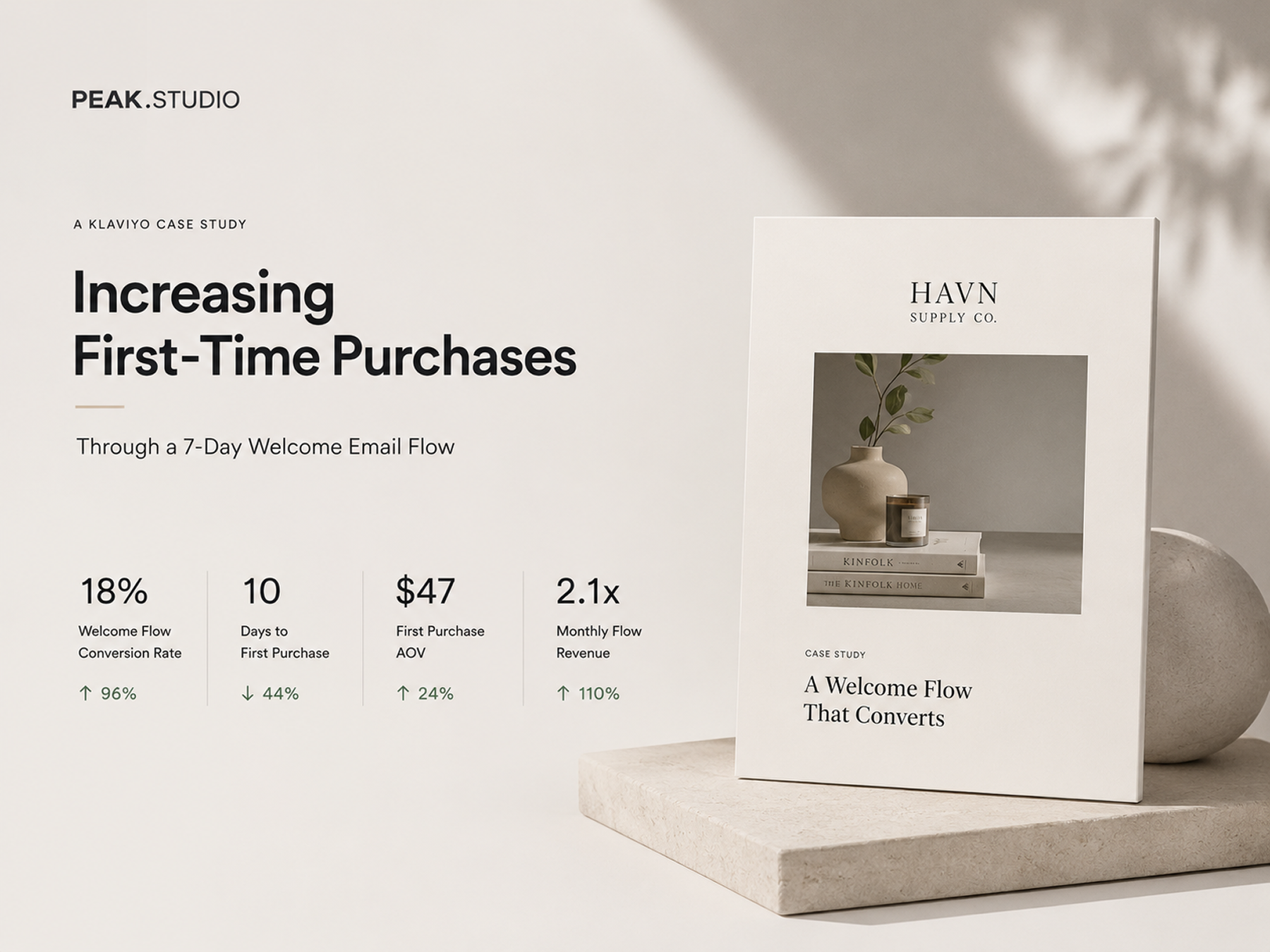
Increasing First-Time Purchases Through a Welcome Flow
+0%
+0.0x
-0%
The Client
Havn Supply Co. is a home goods brand that sells candles, diffusers, and linen accessories with a clean, minimal aesthetic.
Their typical customer is a woman between 28 and 44 who discovers the brand on social media, visits the site a few times while considering, and eventually buys when something clicks, whether that's the look, the story, or how the brand makes her feel.
The Problem
-
A single discount email tells subscribers the brand's only value proposition is price. It trains the audience to expect discounts before buying. A dynamic that's hard to unwind.
-
There was no brand story, no product education, and no reason for a new subscriber to feel connected to the brand before the offer landed. The 10% off email was doing all the work in a single shot.
-
Subscribers who didn't convert on the first email were falling into a cold segment with no further nurture path. The list was growing but not converting.
The Goal
-
Build a welcome sequence that converts subscribers into first-time buyers within 7 days
-
Establish brand positioning and trust before any offer is introduced
-
Reduce the discount dependency on the first purchase without losing conversion rate
The Strategy
1. A five-email welcome sequence over 7 days
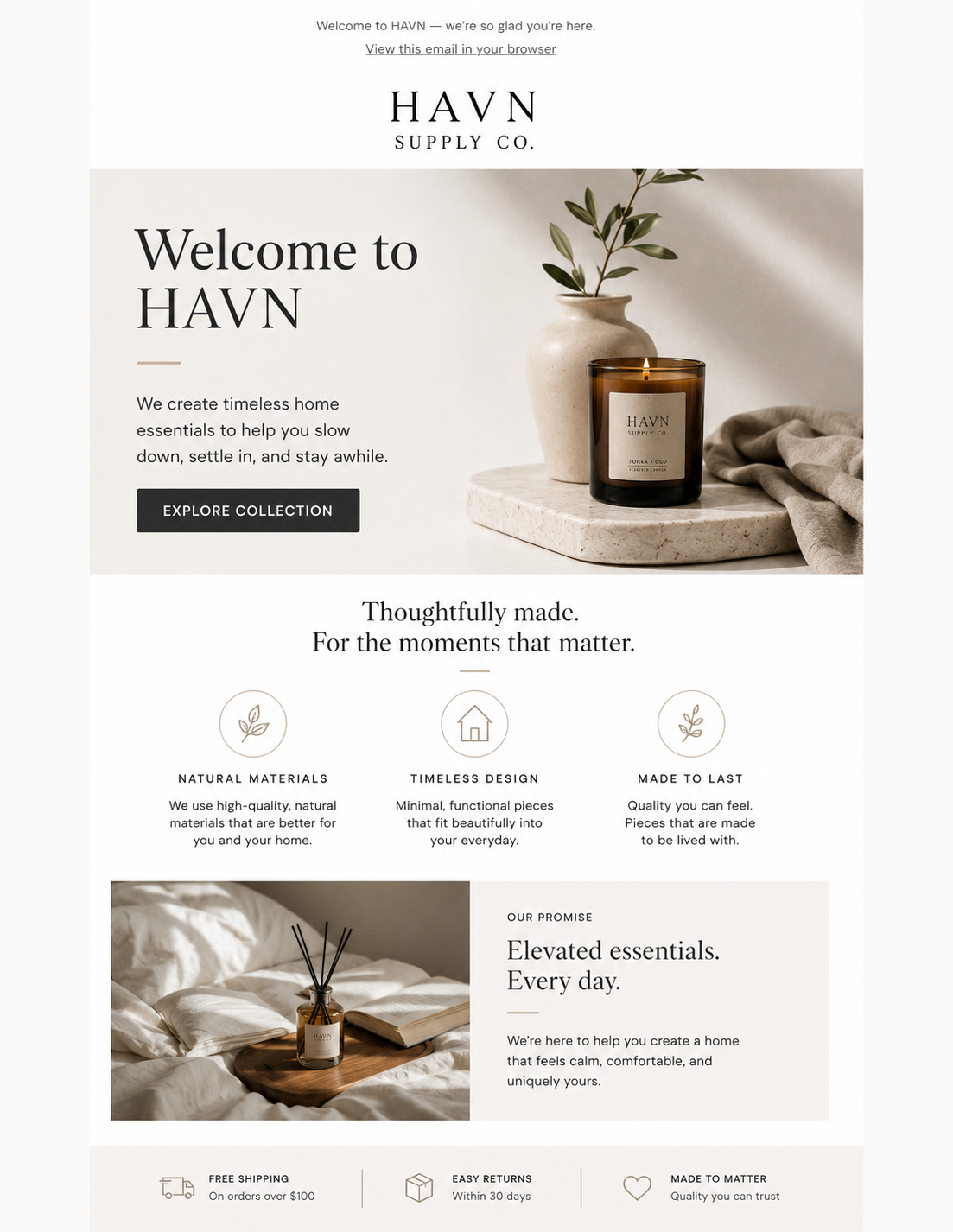
Email 1 (immediate): Brand welcome with a founder note, the brand's origin story, and one visual product showcase. No offer. This email was about earning attention, not converting it.
Email 2 (Day 2): The 'why behind the product' email, materials sourcing, the craft process, the sensory philosophy behind the range. Built on positioning without discounting.
Email 3 (Day 3): Social proof. A curated selection of customer stories and a 'best-sellers' framing to create social consensus around the most popular SKUs.
Email 4 (Day 5): The offer email, a 10% welcome discount introduced in the context of the brand story, with urgency (7-day expiry). By this point, subscribers had seen the brand, the product, and the social proof before the offer appeared.
Email 5 (Day 7): A soft follow-up for non-converters. Not a reminder of the discount, a question ('Still figuring out where to start?') with a product quiz link that personalised the recommendation based on room type and scent preference.
2. The offer was earned, not immediate
Moving the discount from Email 1 to Email 4 was the most contested decision in the build. The data supported it: when the offer appeared after brand and product context, conversion on the discount email was nearly 2x higher than when the same offer appeared on Email 1 in isolation. Subscribers who received narrative first converted at higher rates and at higher average order values.
3. A product quiz as a conversion bridge
For the 30% of subscribers still unconverted after Email 5, a product recommendation quiz was built and linked from the final email. The quiz asked three questions (room type, scent preference, occasion) and surfaced a personalised product recommendation. Quiz completions converted to first purchases at 19%, extending the welcome flow's reach beyond the seven-day window.
The Results
| Metric | Before | After |
|---|---|---|
| Welcome Flow Conversion Rate | 9.2% | 18% |
| Avg. Time to First Purchase | 18 days | 10 days |
| First Purchase AOV | $38 | $47 |
| Flow Revenue (Monthly) | Baseline | +2.1x |
| Discount-Driven Conversions | 100% | 71% |
Welcome flow conversion went from 9.2% to 18% and the average order value on first purchase increased from $38 to $47. Subscribers converted at higher rates and spent more when the offer appeared after brand education, not before.
The Takeaway
A welcome flow that leads with a discount is starting the customer relationship on the wrong foot. The highest-leverage change here wasn't a better offer and it was sequencing. Brand story first, product education second, social proof third, offer fourth. That order changes what the discount means to the subscriber when it arrives.