


How We Helped a Skincare Brand Make 2.8x More Money From Online Shopping Carts People Left Behind
+0.0%
+0.0x
+0.0%
The Client
Luma Botanicals sells plant-based skincare online. Their customers are big researchers. They compare products, read ingredients, and think hard before buying, which means a lot of them add items to their cart and then walk away without paying.
When they came in, the abandoned cart flow was a single automated email sent 24 hours after abandonment. No segmentation. No sequence. No urgency. Revenue from the flow was near zero.
The Problem
Three issues were stacking on each other:
-
They sent just one automatic email 24 hours after someone left. If the customer didn't buy from that single email, they were gone for good.
-
Waiting 24 hours was too long. By then, the customer had already cooled off and forgotten about the excitement of buying.
-
They treated everyone exactly the same. Someone who left a cheap $30 cleanser got the same generic email as someone who left a big $120 bundle.
The Goal
-
Build a multi-step cart recovery sequence that re-engages at the right moments
-
Segment by cart value to personalise the offer and messaging
-
Recover revenue from high-value abandoners without training the entire list to wait for a discount
The Strategy
1. A three-email sequence built around timing, not just discounts
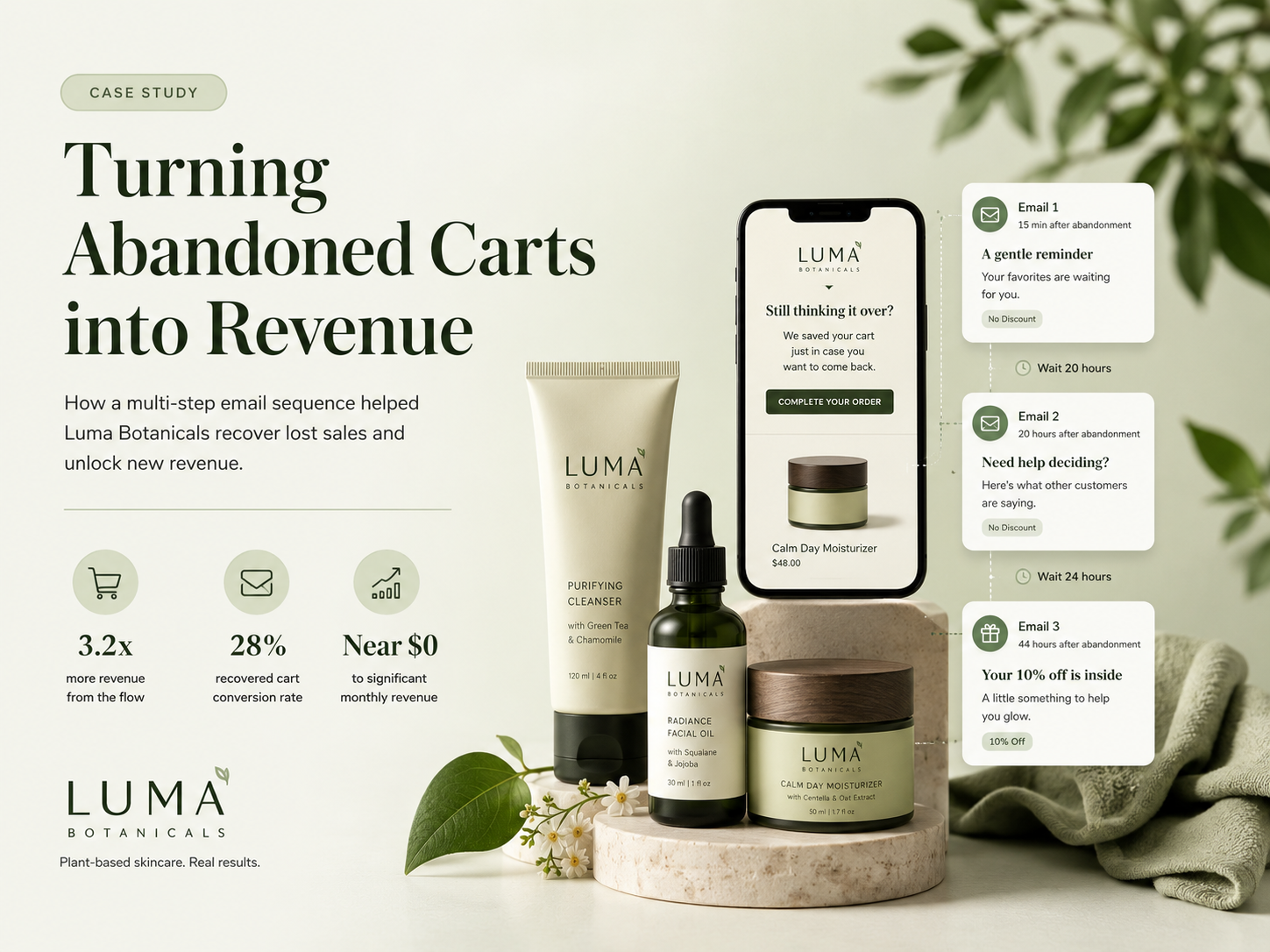
Email 1 went out 45 minutes post-abandonment, a plain-text, curiosity-led nudge that felt like a personal note rather than an automated blast. No discount. Just a soft reminder and a product benefit anchor.
Email 2 landed at the 24-hour mark with social proof: customer reviews specific to the abandoned SKU and an ingredient explainer. Still no discount, the goal was to resolve the objection, not override it.
Email 3 sent at 72 hours to high-cart-value abandoners only, with a time-limited offer (10% off, 48-hour expiry). Low-cart-value abandoners received a softer version without the discount.
2. Segmentation by cart value
Cart value was used as the primary segmentation variable. Carts above $80 received a three-email sequence with a discount unlock on email 3. Carts under $80 received a two-email sequence focused entirely on education and social proof, protecting margin while still driving recovery.
3. Product-specific copy
Each email pulled the abandoned product name and category dynamically into the body copy. A customer abandoning a vitamin C serum got messaging about oxidative stress and glow. Someone abandoning a facial oil got messaging about barrier repair. Generic cart emails were replaced with content that matched the customer's specific intent signal.
The Results
| Metric | Before | After |
|---|---|---|
| Cart Recovery Rate | 3.1% | +14.5% |
| Flow Revenue (Monthly) | Baseline | +2.8x |
| Average Recovered Order Value | $12.20 | $18.40 |
| Emails to Conversion | 1 (24hr) | Avg. 1.7 emails |
| Discount Dependency | 100% of recoveries | 41% of recoveries |
The Best Part: More than half of the people who came back to buy did it without getting any discount at all. This proves that if you send the right message at the right time, you don't have to lower your prices to get the sale.