10 Email Marketing Strategies That Actually
Drive Revenue for Ecommerce Brands
Duy
01 February 2026
Email marketing has changed significantly over the last few years.
What used to be a simple promotional channel has evolved into one of the
most important revenue drivers for modern ecommerce brands. As paid
advertising costs continue to rise across Meta, Google, and TikTok, more
brands are realising that long-term growth doesn’t come from acquisition
alone, it comes from retention.
That’s where email marketing becomes incredibly powerful.
A well-built email marketing strategy helps brands create stronger customer
relationships, improve retention, increase repeat purchases, and generate
more predictable revenue over time. Instead of relying solely on paid
traffic, brands can maximise the value of the customers they already have.
The challenge, however, is that many e-commerce businesses still approach
email marketing the wrong way.
Sending generic campaigns to an entire database is no longer enough.
Customers expect personalised experiences, relevant communication, and
genuine value from the brands they engage with.
The ecommerce brands seeing the best results today are building complete
lifecycle marketing systems combining automation, segmentation, data, and
creative strategy to deliver highly relevant experiences at every stage of
the customer journey.
In this guide, we’ll break down 10 email marketing strategies that ecommerce
brands can use to improve engagement, increase customer lifetime value, and
drive more revenue from retention marketing.
Why Email Marketing Still Delivers One of the
Best ROIs in Ecommerce
Despite the rapid growth of social media and paid advertising, email
marketing continues to deliver one of the highest returns on investment in
digital marketing.
The reason is fairly straightforward: unlike paid channels, email gives
brands direct ownership of their audience.
Algorithms change constantly. Ad costs fluctuate daily. But your email list
is an owned asset that allows you to communicate directly with customers
whenever you need to.
For ecommerce brands, email marketing can support:
Repeat purchases
Customer retention
Product education
Brand loyalty
Cart recovery
Customer re-engagement
Upselling and cross-selling
Long-term revenue growth
More importantly, email marketing compounds over time.
As your subscriber base grows and your automations improve, the revenue
generated from email becomes increasingly scalable and predictable.
That’s why retention-focused brands continue investing heavily in lifecycle
marketing systems rather than relying entirely on paid acquisition.
1. Build a Welcome Flow That Introduces the
Brand Properly
Your welcome flow is one of the most important automations in your entire
email marketing setup.
When someone subscribes to your list, engagement levels are typically at
their highest. This is your best opportunity to introduce the brand, build
trust, and encourage a first purchase.
Unfortunately, many brands waste this opportunity with a single generic
“Thanks for subscribing” email.
A high-performing welcome sequence should feel intentional and structured.
It should:
Introduce the brand story
Explain what makes the products different
Highlight best sellers
Build credibility through reviews or testimonials
Set expectations for future emails
Offer a compelling first-purchase incentive
Strong welcome flows also focus heavily on customer experience rather than
immediate hard selling.
The goal is to build trust first.
Customers who understand the brand are far more likely to convert and become
repeat purchasers later on.
For many ecommerce brands, the welcome flow consistently becomes one of the
highest revenue-generating automations across the entire retention system.
2. Segment Your Audience Instead of Sending
Generic Campaigns
One of the most common mistakes brands make is sending the same email to
their entire database
Modern consumers expect personalised experiences. If your messaging feels
irrelevant, engagement drops quickly.
Segmentation allows brands to send more relevant emails based on customer
behaviour, purchasing patterns, and engagement history.
Some of the most effective ecommerce segments include:
First-time customers
VIP customers
Repeat purchasers
High average order value customers
Inactive subscribers
Recent purchasers
Product category interests
Geographic location
Loyalty members
The more relevant the message, the more likely customers are to engage with
it.
Good segmentation improves:
Open rates
Click-through rates
Conversion rates
Customer retention
Revenue per recipient
It also reduces unsubscribe rates because customers receive emails that
actually align with their interests.
Personalisation is no longer optional in ecommerce email marketing. It’s
expected.
3. Optimise Your Abandoned Cart Flow
Cart abandonment remains one of the largest missed revenue opportunities for
ecommerce brands.
Most customers who abandon their carts aren’t necessarily uninterested. Often
they become distracted, compare alternatives, or simply need more time
before purchasing.
A properly optimised abandoned cart flow helps recover a significant
percentage of that lost revenue automatically.
High-performing cart recovery emails often include:
Product imagery
Clear calls-to-action
Customer reviews
Social proof
Shipping information
Urgency messaging
Incentives where appropriate
Timing is also incredibly important.
In many cases, the first email performs best when sent within the first few
hours after abandonment.
Brands should also test:
Subject lines
Discount offers
Email timing
Design layouts
SMS integration
Small improvements within abandoned cart flows can generate substantial
increases in revenue over time.
4. Focus on Lifecycle Marketing Instead of
One-Off Campaigns
The strongest ecommerce brands don’t rely entirely on promotional campaigns.
Instead, they build complete lifecycle marketing systems designed to
communicate with customers throughout every stage of the customer journey.
Lifecycle email marketing includes:
Welcome sequences
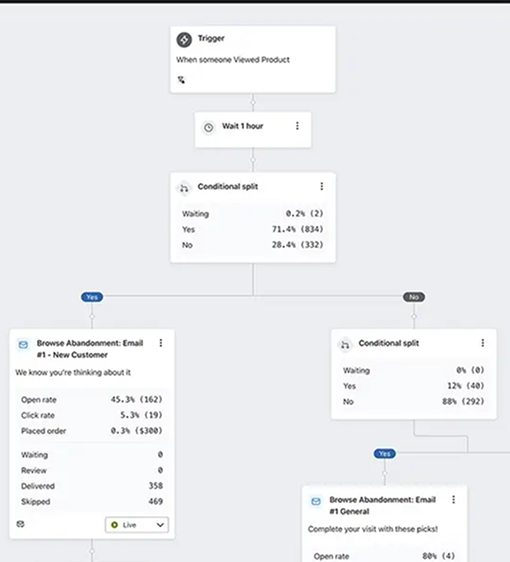
Browse abandonment flows
Cart recovery
Post-purchase flows
Win-back campaigns
VIP campaigns
Loyalty campaigns
Product education flows
Replenishment reminders
This creates a far more consistent customer experience while increasing
customer lifetime value over time.
Rather than constantly chasing new customers, brands can maximise revenue
from their existing audience.
That’s where retention marketing becomes incredibly powerful.
“Success in ecommerce is the result of shifting your mindset
from one-off acquisitions to compounding customer retention.”
5. Use Personalisation Beyond First Names
Adding a customer’s first name to a subject line is not real personalisation
anymore.
Modern personalisation is behavioural.
The best ecommerce brands use customer data to tailor:
Product recommendations
Dynamic content blocks
Product education
Replenishment reminders
Purchase-based upsells
Category-specific campaigns
Customers respond far better when emails feel genuinely relevant to their
interests and behaviour.
Effective personalisation creates a more premium customer experience while
improving engagement across the entire retention system.
6. Improve Deliverability Before Scaling Email
Volume
Deliverability is one of the most overlooked parts of email marketing.
Many brands focus heavily on creative and strategy while ignoring whether
emails are actually landing in the inbox.
Poor deliverability can quietly damage campaign performance over time.
Some of the most important deliverability practices include:
Removing inactive subscribers
Warming domains correctly
Monitoring sender reputation
Maintaining healthy engagement
Avoiding spam-trigger language
Sending consistent volumes
Using proper authentication protocols
Strong deliverability protects long-term account health and improves campaign
performance across the board.
Without good deliverability, even the best campaigns underperform.
7. Combine Email and SMS Marketing Strategically
Email and SMS perform best when they work together as part of a broader
retention strategy.
Email is ideal for:
Storytelling
Product education
Long-form content
Brand building
SMS works particularly well for:
Flash sales
Shipping updates
Cart reminders
Limited-time offers
Back-in-stock alerts
Combining both channels creates a more cohesive customer journey while
improving overall engagement and conversion rates.
The key is making sure both channels feel coordinated rather than
overwhelming.
8. Design Emails for Mobile-First Experiences
Most ecommerce emails are now opened on mobile devices.
If your emails aren’t optimised for mobile, customer engagement suffers
immediately.
A mobile-first email experience should include:
Clear formatting
Short paragraphs
Easy-to-read typography
Strong CTA buttons
Responsive layouts
Fast-loading imagery
Customers should be able to understand the message and take action within
seconds.
Simple, clean email design almost always outperforms cluttered layouts.
9. Continuously Test and Optimise Campaign
Performance
Email marketing should never operate on assumptions.
The best-performing brands consistently test and optimise based on customer
behaviour and performance data.
Areas worth testing include:
Subject lines
Preview text
CTA placement
Email timing
Offers
Creative layouts
Product recommendations
Copy length
Over time, these incremental improvements compound significantly.
Data-driven optimisation is often what separates average retention systems
from highly profitable ones.
10. Retention Is Becoming More Important Than
Acquisition
As customer acquisition costs continue increasing, retention marketing
becomes even more valuable.
Acquiring new customers is expensive.
Retaining existing customers is significantly more profitable.
Brands with strong retention systems typically see:
Higher repeat purchase rates
Stronger customer loyalty
Better margins
Higher lifetime value
More predictable growth
Email marketing plays a central role in building those long-term customer
relationships.
For modern ecommerce brands, retention is no longer an optional growth
strategy — it’s essential.
How Peak Helps Ecommerce Brands Grow Through
Retention Marketing
At Peak, we help ecommerce brands build high-performing retention
systems designed to drive long-term revenue growth.
Our approach combines:
Email marketing strategy
Lifecycle automation
Advanced segmentation
Retention-focused design
Deliverability optimisation
Conversion copywriting
Revenue reporting and analysis
Rather than sending random campaigns, we build structured retention
ecosystems that improve customer experience while generating measurable
business growth.
Every brand is different, which is why our strategies are built around
customer behaviour, data, and long-term scalability.
Final Thoughts
Email marketing remains one of the most profitable channels available to ecommerce brands — but success today requires far more than sending occasional promotions.
The brands seeing the strongest growth are investing in:
Personalisation
Lifecycle automation
Customer retention
Segmentation
Data-driven optimisation
When done properly, email marketing becomes more than a marketing channel.
It becomes a scalable revenue engine that strengthens customer relationships and supports sustainable business growth long term.
For ecommerce brands looking to grow efficiently in 2026 and beyond, retention marketing should be a core part of the strategy and not an afterthought.
About Author
Duy
Duy specialises in the science of keeping customers coming back. With deep expertise in lifecycle segmentation, behavioural triggers, and email automation, he builds retention systems that compound revenue over time, not just at the point of sale. He's obsessed with the numbers: open rates, repurchase cycles, LTV curves, and what the data is quietly telling you about your customers. At Peak, Duy ensures every campaign is built on a strategy that actually moves the needle long-term.